

Key Takeaways
- —The title deed type (Turkish, equivalent, allocation) and the independent research certificate to be obtained from the Land Registry Office are the first things to check before purchasing.
- —Foreign buyers (including Turkish citizens) must obtain permission to acquire real estate and take into account the rule of one property per person.
- —The developer's delivery history, the total cost of the payment plan, and site fees are items to consider beyond the advertised price.
- —Evaluating the location by experiencing it in person at different times, rather than just on a map, will prevent surprise disappointments.
- —Additional expenses such as taxes and fees should be included in the budget before purchasing, and current rates should be confirmed with professionals.
Stories of investors buying apartments they like within a week of a holiday are quite common in Northern Cyprus. For some, this works out well, for others, it doesn't. The difference is usually not luck, but what you look for before buying. From the perspective of an investor from Türkiye, we've compiled 10 points that truly make a difference in this process.
1. First, find out the title deed type
There are three main types of title deed (koçan) in North Cyprus: Turkish title deed, equivalent title deed, and allocation title deed. The difference between these three isn't just a matter of naming — it carries a history of past ownership and, for some buyers, forward-looking sensitivities; you can find the details in our article on the difference between Turkish, equivalent and allocation title deeds. Before falling in love with a property, find out clearly from your real estate agent which title deed type that property has, and see the title deed document with your own eyes.
2. Conduct an independent investigation at the Land Registry Office
Trusting what the agent says isn't enough. Request, through the Land Registry and Cadastre Department, a property investigation document (known in the industry as a "search") showing whether there is a mortgage, lien or third-party right on the property; since this document can only be requested by the owner or someone authorized by them, it's obtained from the seller or, with their authorization, through your lawyer. This document is issued within a few days and costs little, but it lets you foresee a major problem that could arise down the line.
3. Work with a reliable and registered real estate agent
As the real estate sector in Northern Cyprus grows, unfortunately, the number of unregistered agents has also increased. Make sure the person or company you work with is well-known in the sector, can provide references, and, if possible, is registered with the Cyprus Turkish Real Estate Agents Association. A good agent won't just show you listings; they will explain the entire process from title deed type to payment plan.
4. Consider the permit required for foreign ownership of real estate
Foreign national buyers (including Turkish citizens) need a property acquisition permit, and this process can take several months. Under the 2026 rules, you must register the contract with the land registry and submit the permit application within one month at the latest after signing. This doesn't prevent the purchase, but it affects your planning — especially if you're coming in with the expectation of "getting the title deed right away," you need to set a realistic timeline. We've detailed this process in our article on whether selling property to foreigners is legal.
5. Know the purchase limit for your nationality
Turkish citizens may acquire a maximum of 6 apartments or 3 two-story detached villas per person; other foreign nationals may acquire a maximum of 3 apartments or 2 villas; every purchase is subject to Council of Ministers approval. If you're planning multiple properties within a family, clarify at the purchasing stage which property will be registered under whose name — correcting this later costs both time and money.
6. Evaluate the location on-site, not just on a map.
A property advertised as "5 minutes from the sea" is very different from actually experiencing that distance on foot. A project seemingly close to the beach in Karaoğlanoğlu might make walking difficult due to the slope of the hill; a plot near the main road in Alsancak might be noisier than you expect in the summer months. If possible, visit the same area both during the day and in the evening to see the traffic and quietness for yourself.
7. Structure your payment plan according to your purpose of purchase.
In Northern Cyprus, long-term, interest-free payment plans are common, especially for sales in the project phase. This may seem appealing, but don't sign without considering the total cost of installments you'll pay until the delivery date, exchange rates, and potential delay scenarios.
Cash or installments?
While there's generally more room for negotiation on cash purchases, checking the developer's delivery history is crucial for installment plans.
8. Research the developer's delivery history
Look at the projects a construction company has completed previously, and if possible, talk to owners who lived in those projects. Past performance in terms of on-time delivery, material quality, and after-sales support is the most reliable indicator for future projects. You can review reference projects via completed projects and villas.
9. Include taxes and additional costs in your budget
On top of the purchase price, items such as title deed fee, VAT (on some transactions), stamp duty, and annual property tax are added; we've compiled when these items are paid in the cost table in our step-by-step purchase process guide. Since these rates can change from time to time, confirm the current rates with your lawyer or financial advisor before purchasing — building your budget solely on the "listing price" can lead to surprise costs at closing.
10. Inquire about the post-sale process and fees
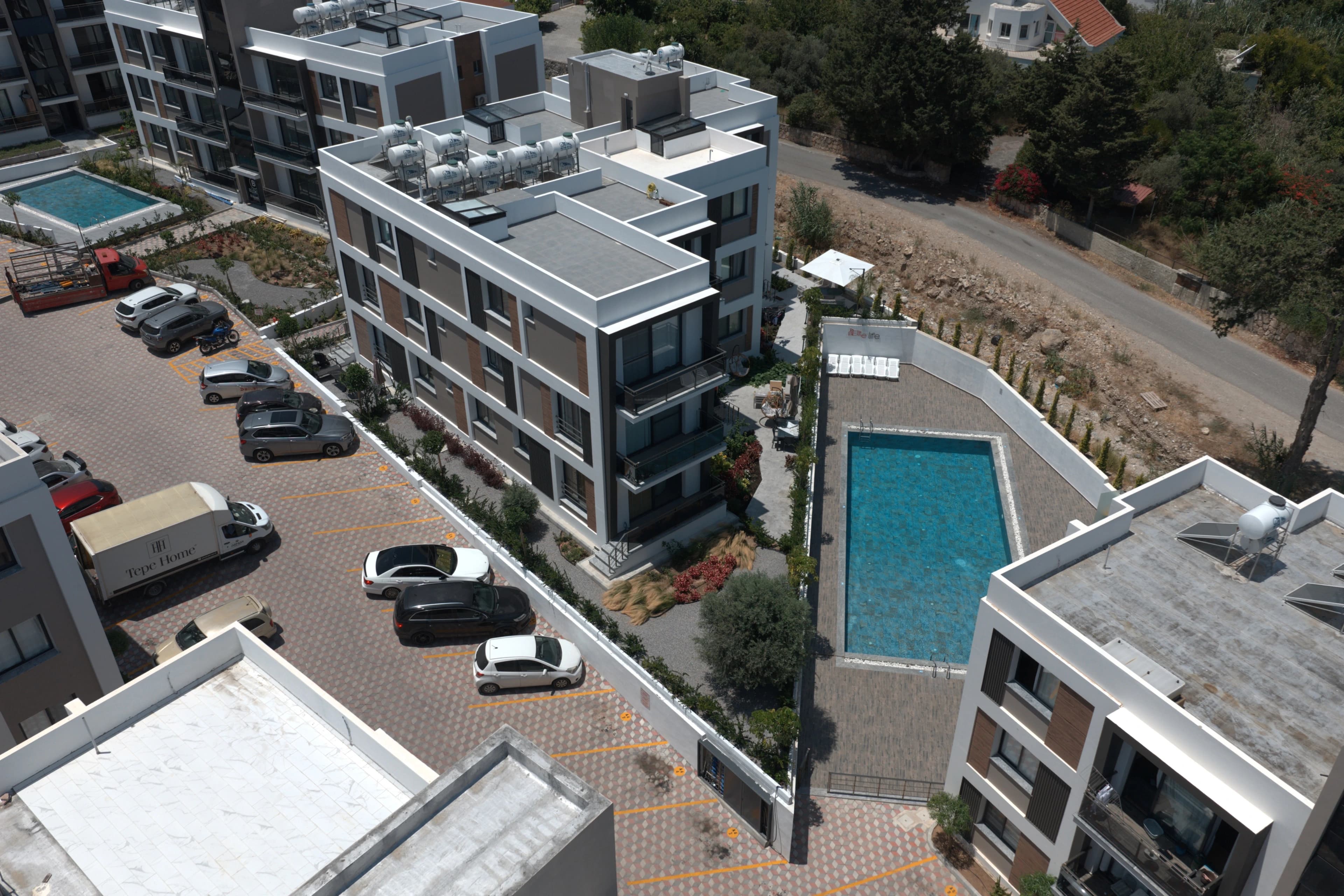
Fees for common areas within the complex, pool maintenance, and security services vary greatly depending on the area and project. The monthly fee for one apartment might be double that of a neighboring complex – this difference directly impacts your total investment cost in the long run. Always request the management plan and current fee amounts before purchasing.
Buying off-plan (during the project phase): three extra checks
A significant portion of sales in Northern Cyprus take place while the building is still at the foundation stage. The price advantage is real, but these purchases require adding three more checks to the ten items above.
Is there a mortgage on the project land?
Developers can mortgage the land to a bank to finance construction. If you see a mortgage in the search certificate, don't panic; but have the contract explicitly state how your unit will be freed from the mortgage (mortgage release) before the title deed transfer.
Building permit and delivery date
Request the date and number of the project's approved construction permit; don't put down a deposit on a project without a permit. The delivery date must be clearly stated in the contract as month/year, and the penalty or rent compensation that applies in case of delay should also be defined.
Tie payments to construction progress
Tying installments to construction stages (foundation, shell, roof, finishing) rather than to a calendar ensures your payments move in parallel with the developer's progress. A company that accepts such a plan is usually one that's confident in its own schedule.
Two extra checks for resale homes
Occupancy permit and unauthorized additions
Enclosed balconies, later-added rooms, or attic floors may have been included in the square footage in the listing. Have the municipality check whether these additions are permitted and whether the house has an occupancy permit (iskân); unauthorized space causes problems both in valuation and in a future sale.
Debt check
Confirm with documentation, before the transfer, that the property has no accumulated property tax, housing complex dues, electricity, or water debt. These debts often become the new owner's problem along with the property.
Final Words
Although these 10 items may look simple one by one, taken together they form the backbone of a sound real estate purchase in Northern Cyprus. Rushing a decision is the biggest risk factor; rather than falling in love with a property during a one-week holiday and signing that same week, being patient enough to at least wait for the title deed check and Land Registry research is the habit that pays off most in the long run. If you're curious about current price levels in the area, you can check our article on real estate prices in Northern Cyprus in 2026.
The tax, fee, and regulatory information in this article is for general informational purposes only; we recommend that you confirm current rates and conditions with your lawyer or financial advisor before purchasing.
Frequently Asked Questions
What is the most common mistake when buying a house in Northern Cyprus?+
One of the most common mistakes is making a quick decision based solely on the listing photo and verbal information from the real estate agent, skipping the title deed type and checking with the Land Registry.
Are there additional risks if I choose a payment plan?+
Long-term payment plans can be advantageous in themselves, but purchasing in installments without researching the developer's delivery history increases the risk; be sure to read the delay clauses in the contract.
Who determines the maintenance fees and taxes after purchase?+
Site maintenance fees are determined by the project developer or site management according to the management plan, while property taxes and fees are determined by the relevant official institutions; both may change over time.
Is buying a home at the project stage risky?+
It can be managed with the right checks. Having it stated in the contract how the mortgage on the land will be removed, an approved construction permit, a clear delivery date with a penalty for delay, and tying payments to construction stages significantly reduce the risks.
What debts should be checked on a resale home?+
Accumulated property tax, site maintenance fees, and electricity and water debts should be verified with documentation before the transfer. It should also be confirmed with the municipality whether there are any unauthorised additions and whether an occupancy permit (iskan) exists.
What is the Search document, and who obtains it?+
It is the immovable property research document prepared by the Land Registry and Cadastre Department; it shows the property's owner, shares, and any encumbrances on it such as mortgages or liens. Since only the owner or a person authorised by the owner can request it, it is usually obtained from the seller or, with the seller's authorisation, from a lawyer.